
The Three Islamic Home Finance Models – Musharakah, Murabaha, Ijara

Shariah-compliant home financing models work by replacing interest-based lending with one of three structures: a cost-plus sale (Murabaha), a lease-to-own arrangement (Ijara), or a co-ownership partnership (Musharakah) where both parties hold equity and share risk. Guidance Residential’s Declining Balance Co-Ownership Program is built on Musharakah, the model most scholars consider the strongest fit in the U.S.
For many Muslims, a home isn’t just about square footage. It’s a path to ownership that aligns with their faith.
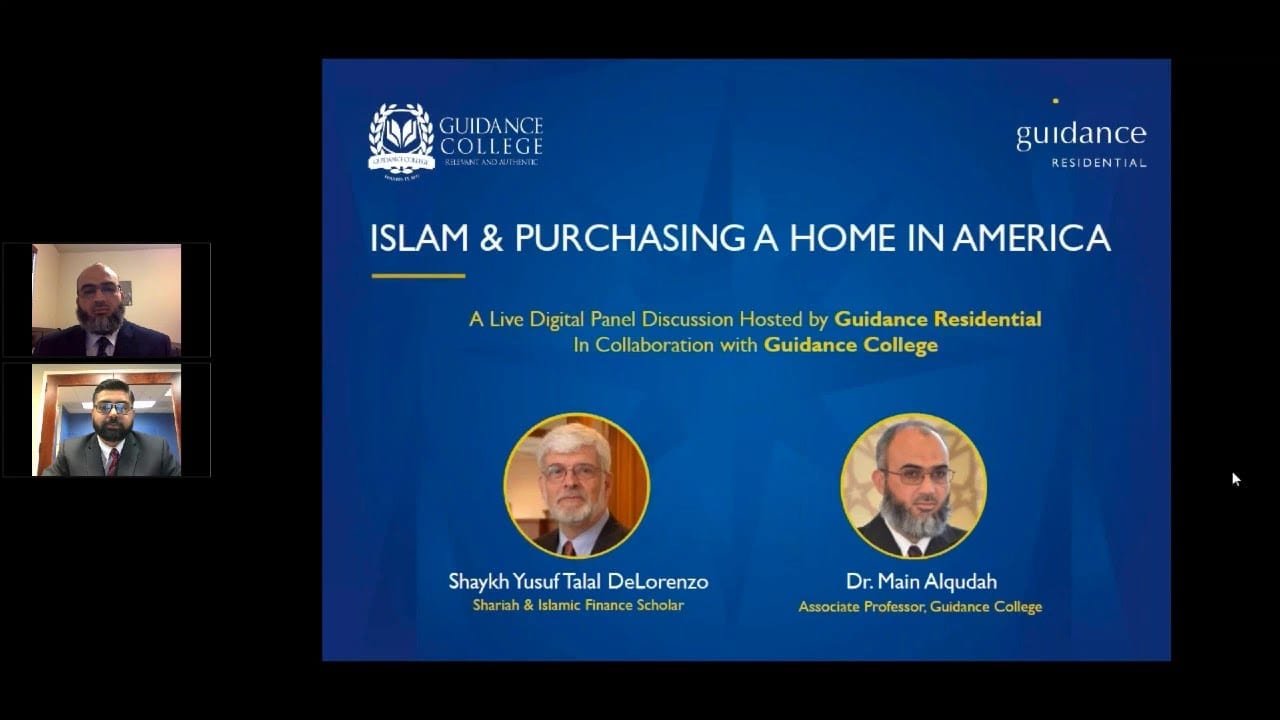
The following video presented by Shaykh Yusuf Talal DeLorenzo addresses the difference between the three Islamic Home Finance Models (Musharakah, Murabaha, Ijara) and the importance of a Shariah board.
What Is Islamic Home Finance?
Islamic finance refers to a system of banking or financial management that is grounded in Islamic principles (Shariah law). Key aspects include the prohibition of interest (usury), known as riba, on loans, and investments in businesses that provide goods or services considered contrary to Islamic values, such as alcohol or gambling, are also forbidden.
This financial system emphasizes risk- and loss-sharing, fairness, and ethical conduct, aiming to create economic justice and ensure that transactions are transparent and equitable for all parties involved.
Islamic finance has gained significant attention in recent years, offering an alternative approach to conventional interest bearing loans. Rooted in Islamic principles and Shariah compliance, it aims to provide ethical, permissible (halal), and socially responsible financial solutions.
Understanding Shariah Compliance
Shariah compliance is the cornerstone of Islamic finance. It ensures that financial practices align with the principles outlined in Islamic law. A key aspect of Shariah compliance is the development of financial products and services that adhere to these principles, providing Muslims with viable alternatives to conventional banking.
How Do Shariah-Compliant Home Financing Models Actually Work?
Each model replaces interest with a different structure. In Murabaha, the financier buys the home and resells it to you at a fixed markup. In Ijarah, the financier buys the home and leases it to you until the term ends. In Musharakah, you and the financier co-own the home from day one, and your payments gradually buy out their share.
Types of Islamic Home Financing
Murabaha
Murabaha transactions involve a financier purchasing a home on behalf of a home buyer and then selling it to the home buyer at a marked-up price, either in a lump sum or with deferred payments.
A Murabaha contract that involves deferred payments has the drawback of creating a type of debt; plus, it does not fulfill the requirement of risk-sharing as the financier does not retain an ownership share. Because of this, murabaha is not considered a preferred model in the United States.
Ijarah
Ijarah is an Islamic financing structure where the bank buys a property on behalf of a customer and leases out the home to them for a fixed rent. The home buyer will then pay monthly payments that include a portion that goes toward purchasing the home. This concept is akin to a rental or leasing agreement, in which the lessee benefits from the asset, and the lessor earns a fixed income from the rent.
Ijarah is compliant with Islamic law; however, it has a major drawback in that the home buyer does not gain full ownership rights until the end of the sales contract term, typically 30 years. For that reason, it also is not a preferred model in the United States.
Musharakah
Musharakah is a form of co-ownership between the home buyer and the financing company. The financier and home buyer agree to invest in a property and purchase the home together as partners.
Each party owns shares in the home based on the percent of the purchase price they contributed. For example, if the home is priced at $100,000 and the customer pays a down payment of 10% (or $10,000) and Guidance Residential contributes 90% (or $90,000), the customer is 10% owner and Guidance is 90% owner.
In a version called Diminishing Musharakah, or the Declining Balance Method, the home buyer gradually buys out the financier’s stake in the property, while paying a fee to use the part of the property still owned by the financier.
Why Is Musharakah the Preferred Halal Home Financing Method in the US?
Musharakah is the most common form of Islamic home financing in America.
This model enables the home buyer to benefit from the advantages of a traditional mortgage loan while maintaining full ownership rights from the beginning. They also receive additional benefits such as enhanced consumer protection, as both parties share in the profit and loss of an investment or business venture.
A Musharakah contract is rooted in the principles of risk and reward sharing and is widely regarded as a fair and equitable form of finance because it includes:
- Partnership (Shirkat al-Milk): Both parties invest in the asset.
- Gradual transfer of ownership: The buyer buys out the financier’s stake in installments.
- No interest involved: Payments go toward ownership and usage rights, not toward riba (interest).
The co-ownership and lease model can be structured to meet U.S. real estate and banking laws without requiring changes to conventional legal frameworks. Many scholars and Shariah boards consider this model more in line with Islamic teachings than other models (like Murabaha, which does not involve the important partnership element).
For these reasons, Guidance Residential favors the use of the Musharakah model in our halal home financing solutions.
Developing an Authentic Islamic Home Financing Model
Guidance Residential was founded in 1999 to fill the need for riba-free and shariah-compliant Islamic home financing in the United States. For many years, American Muslims trying to observe the prohibition on riba had no halal way to buy a home in accordance with their values. Our team began a three-year research and development project involving 18 law firms and six of the world’s leading Islamic finance scholars to develop an authentic home financing model compliant with both U.S. and Islamic legal systems.
After developing its Musharakah Mutanaqisah, or Diminishing Partnership, model of Islamic home financing, Guidance Residential began offering this service to home buyers in 2002.
For 25 years, we have grown substantially, becoming the leading provider of Islamic home financing in the United States. We have provided more than $12 billion in financing, helping nearly 45,000 families on their home ownership journey.
Our ethical home financing service is open to Muslims as well as non-Muslims, and it continues to grow in popularity.
5 Benefits of Guidance Residential’s Co-Ownership Model
In addition to providing a riba-free and shariah compliant alternative to conventional loans, Guidance Residential’s model of Islamic home financing offers additional advantages not found in an interest bearing loan.
1. Risk Sharing
Unlike conventional loans (where the borrower bears nearly all of the risk), the co-ownership arrangement means that both the financial institution and the homeowner share the burden of any potential loss in property value. For example, if insurance doesn’t cover the entire cost for certain natural disasters, any loss would be shared by Guidance Residential and the homeowner in proportion to the share of the property each party owns.
2. Asset Protection
In the case of foreclosure, if the property cannot be sold to recoup the full loan amount, banks often pursue the homeowner’s other assets to recoup their losses. Under Shariah principles, Guidance Residential cannot retrieve more than the specific commodity involved (in this case, the home). Its contracts include a unique “non-recourse” clause that protects all of the customer’s assets other than the property from being subject to foreclosure.
3. Capped Payments
Furthermore, in accordance with Islamic principles, Guidance Residential incorporates a compassionate approach to late payments, featuring capped late payment charges. Only a small flat fee may be charged to cover the costs involved in reaching out to the homeowner for the missing payment. This serves to protect homeowners from excessive penalties and reflects the ethical finance principles upheld in shariah law.
4. No Pre-Payment Penalty
In addition to capped late payments, Guidance Residential does not charge any prepayment penalty (as some banks have traditionally done). If a homeowner wishes to pay off their contract early, they are free to do so.
5. Ongoing Protection
Once the model was developed, however, the work was not over. Customers can rest assured that this riba-free service remains authentic and shariah compliant. We offer ongoing protection by utilizing an independent shariah board.
The Role of an Independent Shariah Board
This halal home financing board consists of scholars well-versed in Islamic law and finance, who provide guidance and oversight. Their expertise helps evaluate financial products and services, ensuring they align with Shariah principles and meet the needs of the Muslim community.
The board audits the company’s procedures and services every year to ensure continued compliance with Islamic principles. They also remain available to answer questions and provide guidance on an ongoing basis.
The presence of an independent Shariah board instills confidence and trust in Islamic financial institutions.
Why Does Islamic Finance Matter to Muslim Americans?
In a world where ethical finance is gaining prominence, Islamic finance stands out as a viable alternative. The Murabaha, Ijarah, and Musharakah models represent different approaches to achieving Shariah compliance in financial transactions. By upholding the principles of Islamic law and incorporating an independent Shariah board, Islamic financial institutions can provide ethical and sustainable solutions. As Islamic finance continues to evolve, it holds the potential to shape a more inclusive and socially responsible financial landscape.
Islamic finance offers a unique approach to financial matters, integrating ethical considerations and social responsibility. It provides an opportunity for individuals to engage in financial activities while adhering to their religious beliefs. By emphasizing fairness, transparency, and responsible investment, Islamic finance strives to create a more equitable and inclusive financial system.
Frequently Asked Questions
Why is Musharakah considered the preferred model in the U.S.?
Musharakah is the only one of the three models where both parties hold ownership and share risk for the full term. Murabaha creates a fixed debt at sale, and Ijara leaves the homebuyer without equity until the term ends. Because Musharakah avoids both drawbacks, most Western Islamic finance scholars consider it the strongest fit, and it’s the model Guidance Residential uses.
Are Murabaha and Ijara still valid Islamic financing options?
Yes. Both models are accepted forms of Islamic finance and avoid interest. But each has practical drawbacks in the U.S.: Murabaha’s fixed-price sale creates debt that can’t be securitized because it is not permitted to sell debt under Islamic law, and Ijara delays ownership until the contract ends. Musharakah avoids both issues, which is why most U.S. providers, including Guidance Residential, prefer it.
Why does a Musharakah profit rate look similar to a conventional interest rate?
Guidance benchmarks its usage fee against conventional financing costs to create a sustainable business model and so homebuyers can compare pricing side by side. A similar-looking number doesn’t turn the payment into interest, though. In Musharakah, you and the financier buy the home together as partners; you aren’t borrowing money, so you aren’t paying interest.
Does the financier share in risk under a Musharakah model?
Yes. Guidance shares in certain losses in proportion to its ownership share. If a natural disaster damages the home and insurance doesn’t cover the full cost, Guidance covers its percentage of the remaining loss. In a conventional mortgage, that risk falls entirely on the homeowner.
Is Islamic home financing harder to qualify for than a conventional mortgage?
No. The qualification process is similar to a conventional mortgage. Homebuyers provide standard documentation, such as tax forms and pay stubs, and the financier runs a credit check. Approval depends on the same financial factors a conventional lender would evaluate.
Find Ethical Home Financing That Is Right for You
Guidance Residential remains the #1 U.S. Islamic home financing provider. Over the past 25 years, we have assisted nearly 45,000 families. Learn more and get started on your home finance journey today.
Your Guidance Residential Account Executive is here to help with any questions. Looking to refinance or purchase? Have a friend or family member who is looking for a home? Call 1.866.Guidance, or start an application today.
Originally published in July 2020, last updated in August 2026.