
Five Principles of Islamic Finance

Islamic finance is more than a religious obligation: It’s a blueprint for a more just, equitable, and stable community.
Rooted in divine guidance and centuries of scholarly tradition, its principles address some of the most pressing problems in modern economics: growing inequality, predatory debt, speculative instability, and a widening divide between those who hold wealth and those who don’t.
Here are five principles of Islamic finance that work together to create a financial system that works for people — not against them.
1. Divine Guidance and the Prohibition of Harmful Practices
At its core, Islamic finance is governed by Shariah — the ethical and legal framework derived from the Quran and the Sunnah (the teachings and practices of the Prophet Muhammad, peace be upon him). This divine foundation is what sets Islamic finance apart from every other financial system in the world.
Islamic finance principles are financial guidelines based on the Quran and Sunnah that promote ethical earning, fairness in trade, prohibition of interest, and responsible wealth distribution.
Riba
Most prominently, Islamic finance strictly prohibits riba, the charging or payment of interest. A loan in Islam is meant to be an act of charity, not an opportunity to earn wealth from someone who may already be struggling. Interest charged on a loan is considered exploitative and is not a lawful source of income.
Other Harmful Practices
Along with forbidding riba, Shariah law also prohibits investing in or supporting businesses that deal in other enterprises that are considered harmful, such as gambling operations or selling pork or alcohol. Islamic finance also bans contracts involving excessive ambiguity (gharar) and speculative investments (maysir). This can reduce the risk of financial fraud and irresponsible market behavior.
The goal is not restriction for its own sake — it is protection. These rules exist to prevent the kinds of financial behaviors that destabilize societies and exploit the vulnerable.
2. Fairness and Equitable Distribution of Wealth
In a world where the gap between rich and poor continues to widen, Islamic finance takes a firm stand for fairness.
Along with exploiting the poor, interest concentrates wealth in the hands of the rich, who earn money without investing in business and without taking on any risk. The wealthy lend, the interest compounds, and their fortunes grow — not because they created anything of value, but simply because they had money to begin with.
Meanwhile, borrowers (often those with the fewest options) carry all the risk and all the burden.
Wealth Tied to Participation
Islamic finance identifies this dynamic as fundamentally unjust and prohibits it. Wealth should be earned through initiative, investment, and risk on the part of the people who stand to benefit — not by extracting money passively from those who have no choice but to borrow.
By removing interest from the equation, Islamic finance disrupts the mechanism by which money endlessly flows upward, and replaces it with a system where returns must be tied to genuine participation in productive activity.
This commitment to fairness is not incidental to Islamic finance — it is one of its central purposes. A financial system that allows the rich to grow richer simply by holding wealth, while the poor grow poorer simply by needing it, is not a neutral system. It is a machine for inequality. Islamic finance provides a healthier alternative.
3. Circulation of Wealth
If wealth cannot be hoarded by a small number of rich people through an interest-based economy, one result is that money circulates more freely through the economy. The wealthy will look to other forms of business and investment that create jobs and otherwise provide a greater benefit to society.
Without the option to simply lend money and collect guaranteed returns, the wealthy are compelled to seek other forms of investment that require genuine participation, carry real risk, and generate real benefit. They start businesses. They fund entrepreneurs. They invest in real estate, agriculture, trade, and industry. In doing so, they create jobs, build communities, and contribute to an economy that works for more than just themselves.
In joint investment ventures like these, people with capital and those with ideas and labor come together as genuine partners. The person with wealth cannot simply sit back and collect a guaranteed return while others do all the work and bear all the risk. They must invest and share in whatever outcome follows. The sharing of both benefit and risk provides a greater incentive to make sound business decisions.
A Healthier Economy
An economy is healthiest when capital is active, not passive. When money moves through businesses and people’s hands rather than accumulating quietly in the accounts of those who already have the most, the whole of society benefits. A community where wealth circulates rather than pools at the top sees more opportunity, more enterprise, and more shared prosperity.
Islamic finance doesn’t just prohibit a harmful practice here; it redirects the energy of wealth toward something constructive.
4. Asset-Backed Transactions and the Rejection of Pure Speculation
Every transaction in Islamic finance must be tied to a real, tangible asset — land, goods, or services. Money is not a tangible asset, so a loan in which a person is given money now in return for more money later is not an asset-backed transaction.
Asset-backed financing ensures that economic activity grows on a foundation of tangible value rather than risky speculation. It connects the financial system to the real economy and prevents the kind of runaway speculation that has triggered financial crises around the world.
Preventing Crises
Following this principle could have prevented the 2008 global financial crisis, in which toxic debt instruments and high-risk derivatives brought conventional financial institutions to their knees. When finance is rooted in actual assets and productive activity, it is far more resilient to the kind of cascading failures that speculative bubbles inevitably produce.
Islamic finance prioritizes societal well-being alongside profit-making, unlike traditional banks. A society can enjoy both stability and financial growth when transactions are grounded in real assets and genuine value creation.
5. Risk Sharing and Shared Responsibility
As we’ve seen above, one of the most transformative principles of Islamic finance — and the one that most directly challenges the conventional financial model — is risk sharing. In a traditional mortgage or loan, the borrower carries almost all the financial risk. If the value of a home drops, if a business fails, if circumstances change, the lender is still owed every penny of interest. The borrower bears the loss alone.
Islamic finance rejects this model entirely.
Rather than a lender/borrower relationship, halal financing is structured as an investment in which both parties share profit and loss. This creates a fundamentally different dynamic — one built on mutual accountability and aligned interests. When a financier shares in the risk, they have every reason to want the borrower to succeed.
Islamic finance encourages profit-sharing models where both risk and reward are shared between the institution and the customer.
Who Decides What Is Shariah-Compliant?
With those crucial principles in mind, this could lead to a question: Who decides whether a financial product is truly halal?
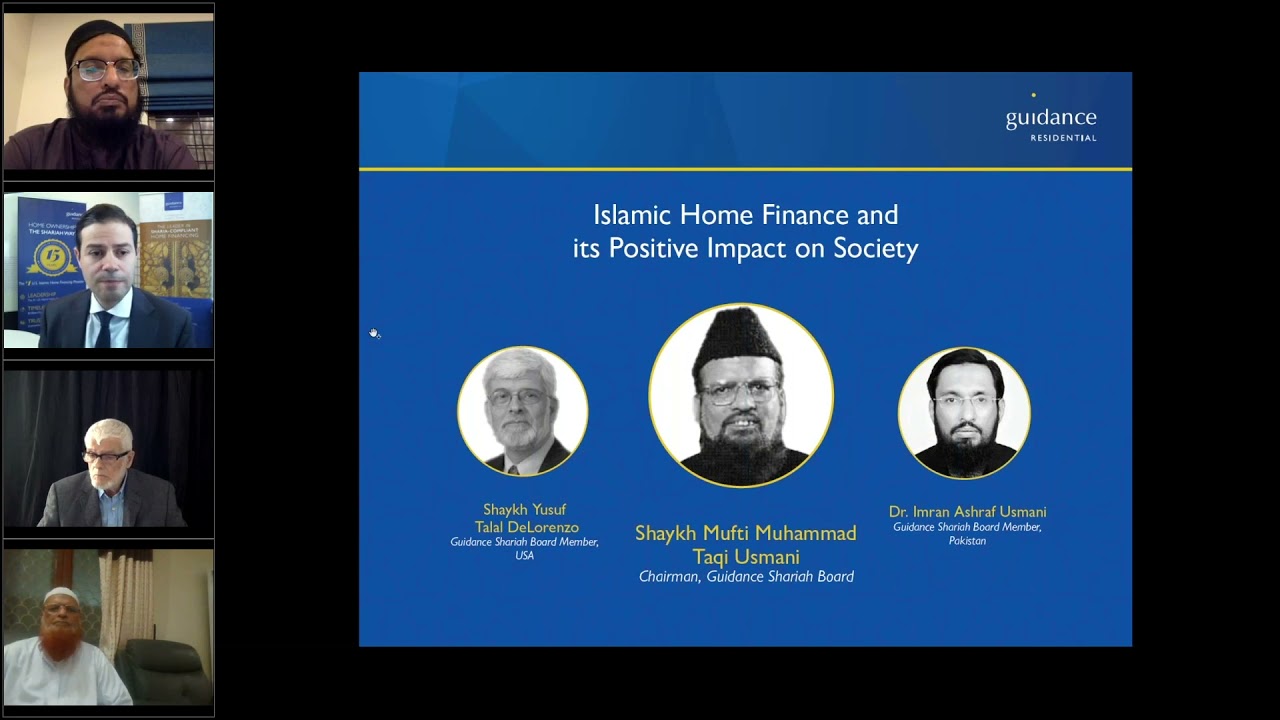
The answer lies in a rigorous system of scholarly oversight. To ensure that Shariah principles are upheld, upstanding Islamic financial institutions are guided and monitored by independent Shariah Supervisory Boards composed of qualified Islamic scholars who specialize in Islamic jurisprudence, economics, and finance. Their role is to evaluate and approve financial products and contracts, ensure compliance with Shariah rules, and oversee the practical implementation of Shariah-compliant practices within the institution.
A Shariah board decides what is allowed (halal) or forbidden (haram) based on the two main sources of Islamic law: the Quran and the Sunnah.
At an international level, two supervisory bodies oversee Islamic finance globally: the Bahrain-based Accounting and Auditing Organisation for Islamic Financial Institutions (AAOIFI) and the Malaysian Islamic Financial Services Board (IFSB).
Evaluating a Shariah Board
The quality and credibility of a Shariah board matters enormously. A board composed of a small number of local scholars with limited independent expertise offers far less assurance than one made up of five or more internationally recognized scholars with deep expertise in both Islamic jurisprudence and modern finance.
When choosing an Islamic finance provider, the strength and independence of the Shariah board is an important factor to consider.
Common Questions About Islamic Finance and Home Buying
Now that we understand some of the foundational principles of Islamic finance, a consumer may wonder how they apply to Islamic home financing. The answers to some common questions are below.
Why can’t Muslims have a conventional mortgage?
At the heart of a traditional mortgage loan is the practice of lending and borrowing money at interest, which we have seen is forbidden under Islamic law.
Even some so-called Islamic mortgages are affiliated with traditional banks, which means the source of their funding is based on interest and therefore is not halal or permissible. Furthermore, some of that funding comes from funds generated through lending money to businesses that engage in harmful practices such as gambling or selling alcohol. Nothing about that is ideal from an Islamic perspective.
In addition, a mortgage loan is not an asset-backed transaction. It is essentially selling money now for more money later.
Thankfully, halal alternatives are now available in the West.
Do Muslims get 0% mortgages?
Not exactly. Islamic home financing is free of riba, or interest. But “interest-free” does not mean “cost-free.” The financier still earns a return through another means such as a profit rate, a rental fee, or a share of ownership.
The difference is not the amount paid, which may be competitive with a conventional mortgage in practice. Rather, the difference lies in the structure and the relationship. Islamic home financing with Guidance is a co-ownership arrangement, not a debt-with-interest transaction.
That distinction results in a more equitable relationship between partners. IThat is very different from the unequal relationship between a lender who enjoys most of the benefit while the borrower bears most of the risk.
A Financial System Built for Everyone
These five principles — divine guidance, fairness, circulation of wealth, asset-backed transactions, and risk sharing — are not relics of a distant past. They are a coherent, sophisticated response to the failures and inequities of the modern financial system.
Islamic finance is not only for Muslims. It can appeal to anyone who is interested in a more transparent and ethical system of finance. As interest rates fluctuate, financial crises recur, and the gap between the wealthy and the rest continues to grow, the wisdom embedded in these principles becomes more relevant, not less.
It is not just about profit. It is about prosperity with purpose.
How Guidance Residential Embodies These Five Principles
Founded in 1999, Guidance Residential was built from the ground up on these five principles.
Rooted in divine law
Guidance Residential’s home financing program is certified Shariah-compliant and free of riba. Guidance’s co-ownership model of Islamic home financing USA was structured from inception to comply with Shariah — not adapted from a conventional model with cosmetic changes.
Fairness
Guidance’s model of halal home financing is based on Diminishing Musharakah, a form of a partnership model. The parties are co-owners, not a borrower and lender. An LLC is created for each home purchased, and the parties enter an initiative together as partners.
Circulation of wealth
Providing access to Islamic financing in more than 35 states, Guidance Residential helps families build equity, establish roots, and participate fully in their community. This keeps wealth circulating in the Muslim economy as well as the broader society instead of simply further enriching the wealthiest members of society.
Asset-backed transactions
Every transaction Guidance Residential facilitates is tied to a real property — a tangible asset. There is no speculative component, no financial engineering divorced from real value.
Risk sharing
Guidance Residential’s co-ownership model of Shariah-compliant home financing creates a situation in which both parties share in the real risks and real rewards of a joint investment. This is not a loan dressed up in Islamic terminology. It is a fundamentally different relationship. (Note that the buyer keeps all of the profit when the home is sold – a win-win for the homeowner.)
Take the Next Step on Your Homeownership Journey
If you’re ready to take the next step toward halal homeownership, Guidance Residential offers a trusted path forward, in accordance with the just and ethical principles of Islamic finance.
Buying a home is one of the most important decisions you will make. The team at Guidance Residential is here for you every step of the way, from pre-qualification and pre-approval on through to finding the right real estate agent for you and your family. We invite you to explore the home buying process with Guidance Residential today.
Learn more and get started on your home finance journey today.
Your Guidance Residential Account Executive is here to help with any questions. Looking to refinance or purchase? Have a friend or family member who is looking for a home? Call 1.866.Guidance, or start an application today.
Written in April 2026.