
What Does It Mean to Co-Own a Home as a Muslim?

For many years, Muslims felt alone in their dream of buying a home.
They had two options: Pay in cash, or use a riba-based mortgage loan.
Guidance Residential was founded in 1999 to pioneer a better solution: a truly authentic Shariah-compliant mortgage.
It’s based on the Islamic principle of co-ownership. And you are no longer alone.
This article will explain how an Islamic co-ownership mortgage works.
How Does an Islamic Co-Ownership Mortgage Work?
There are several types of Islamic mortgage models. The one most suitable in the West is co-ownership.
When you buy a home with Guidance Residential, we create an LLC and buy the home with you as co-owners.
You own a share of the property from day one, and Guidance Residential owns the rest, based on the percentage each party pays.
Then, every monthly payment you make transfers more of Guidance Residential’s share to you, until the home is entirely yours.
It’s important to note that you enjoy full ownership rights from day 1.
How Can I Get an Islamic Mortgage Loan USA?
Muslims in the United States can’t get a mortgage loan that is Shariah-compliant.
In Islamic jurisprudence, a loan is meant to be a charitable act. One person lends another money in a time of need, and the borrower repays exactly what was borrowed – no more.
Adding any extra charge to that repayment is riba, and riba is forbidden in Islam. That means a mortgage loan, which is based on interest, or riba, is not an option if other alternatives are available.
How Is Co-Ownership Different From a Loan?
Co-ownership is not a loan with a different name. It is a genuine partnership arrangement rooted in an Islamic finance principle called Diminishing Musharakah.
There is no debt, no interest, and no lender. There are two co-owners, and one of them is working toward buying the other out. The co-ownership agreement is rooted in trade and partnership, not lending. The profit Guidance earns comes from co-owning a real asset and charging the homeowner a fee for exclusive use of the entire property.
How Can I Buy a Home Through Co-Ownership?
Co-ownership can have more than one meaning. When people hear “co-ownership,” they sometimes think of two families buying a home together. That is a different arrangement.
Joint Ownership Between Individuals
One form of co-ownership is when two or more people pool resources to purchase a property. Each holds a legal share. Decisions about the home require agreement from all owners. In Arabic, this form of co-ownership is known as Shirkat-ul-Milk.
This can work well, especially for investment properties. But it has real practical challenges. Owners may disagree on when to sell. Legal disputes can arise. Exit strategies are complex. And if neither party has enough cash to buy outright, they still need financing.
Co-Ownership With Guidance Residential
Co-ownership with Guidance Residential is different. You buy the home together, but you are the only one using it, so that makes the arrangement different. This is called Shirkat-ul-‘Aqd.
Since you are the only one using the home, you pay a profit fee to Guidance. You also pay for the taxes, maintenance, and upkeep, as all of those benefit you directly. If the value of your home increases and you decide to sell it, you also keep all of the profit.
Here are some other benefits of co-ownership with Guidance:
You are the homeowner from day one. In most states, the home is in your name alone at closing. You have full rights to occupy, renovate, and make decisions about the property.
The exit path is defined from the beginning. Your monthly payments are specifically structured to buy out Guidance Residential’s share over the life of the contract. There is no ambiguity about how or when co-ownership ends.
Guidance Residential’s only role is to facilitate your ownership. It has no interest in retaining the property. The structure is designed entirely around transferring full ownership to you.
Risk is shared. Because Guidance Residential is a genuine co-owner, it shares in the risks of homeownership alongside you. This is one thing that makes the relationship fundamentally different from a lender and borrower.
Why the Structure Matters, Not Just the Label
There are financial products in the marketplace that use halal or Islamic language without contracts that have been rigorously reviewed by qualified scholars. A label alone does not make a product Shariah-compliant.
What matters is the underlying structure. Is the profit generated from a loan, or from ownership of a real asset? Is risk shared between both parties, or held entirely by the homebuyer? Is the relationship a partnership, or a lender-borrower dynamic? Is the financier a subsidiary of a riba-based bank or lender, or is it a standalone Islamic institutution?
Guidance Residential’s answers to those questions are what has made it the largest Islamic home financing provider in the United States, with more than 40,000 families served since 2002.
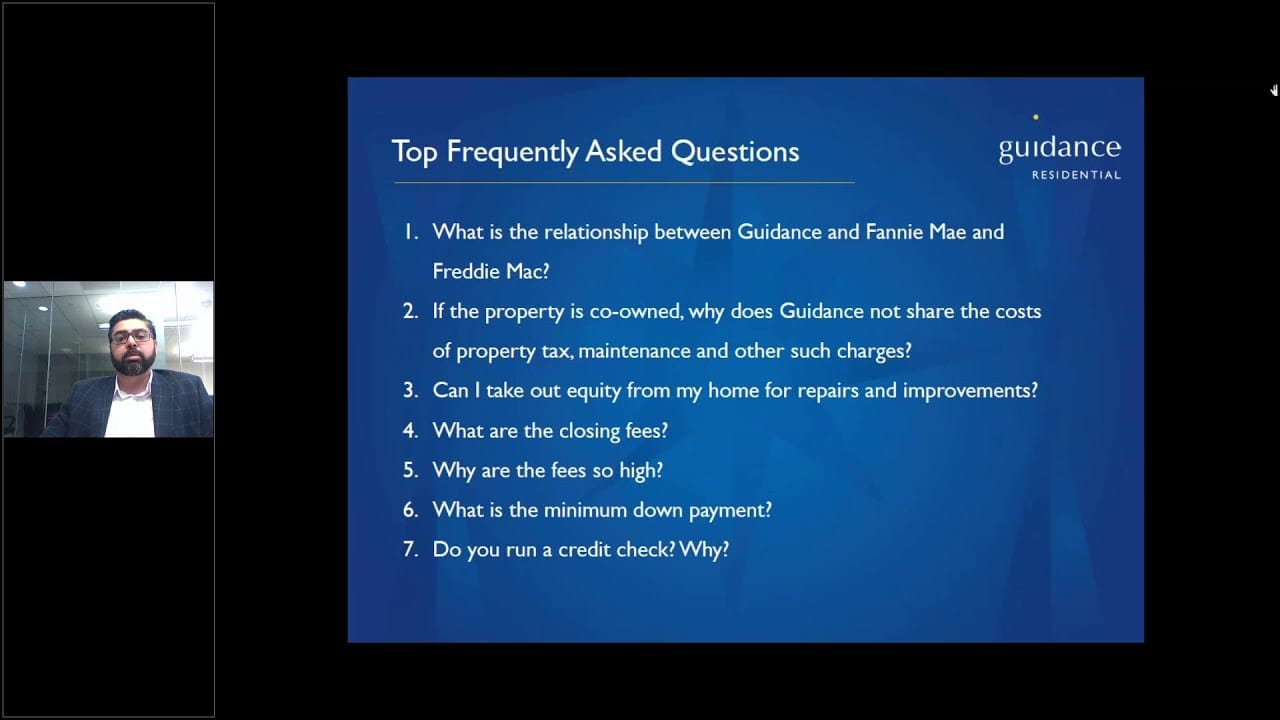
Frequently Asked Questions
What’s the difference between Shirkat-ul-Milk and Shirkat-ul-‘Aqd?
Shirkat-ul-Milk is joint ownership between individuals, like two families buying a property together, where all parties use and hold the asset jointly. Shirkat-ul-‘Aqd, the structure Guidance uses, is a partnership where you are the only one using the home, so you pay a profit fee to Guidance for the share you don’t yet own and you cover maintenance and taxes.
If Guidance owns part of my home, whose name is on the title?
In most states, the home is titled in your name alone at closing, even though Guidance holds an ownership stake through the LLC. You have full rights to make decisions about the property from day one.
Can I make home improvements or renovations before I own the home outright?
Yes. Because you have full ownership rights from day one, you can renovate and make decisions about the property throughout the contract, not just after you’ve bought out Guidance’s full share.
What happens to the co-ownership arrangement if I want to sell before finishing the contract?
You can sell at any point. Any increase in the home’s value belongs entirely to you, and the proceeds are used to buy out Guidance’s remaining ownership share before you receive the rest.
Is co-ownership recognized as a valid homeownership structure under U.S. law?
Yes. Guidance’s contract is built to comply with the same federal, state, and local property and financing laws that apply to any homeownership structure.
Ready to Enjoy Islamic Homeownership?
Buying a home is one of the most important decisions you will make. The team at Guidance Residential is here for you every step of the way, from pre-qualification and pre-approval on through to finding the right real estate agent for you and your family. We invite you to explore the home buying process with Guidance Residential today.
Learn more and get started on your home finance journey today.
Your Guidance Residential Account Executive is here to help with any questions. Looking to refinance or purchase? Have a friend or family member who is looking for a home? Call 1.866.Guidance, or start an application today.
Written in May 2026.