
What Is an Islamic Mortgage and How Does It Work?
An Islamic mortgage is not a loan. It is a riba-free (interest-free) way to finance a home, most commonly through co-ownership: the homebuyer and financier purchase the home together, and the buyer gradually acquires full ownership. Guidance Residential has financed homes this way for nearly 45,000 American families.
Guidance Residential is the #1 U.S. Islamic Home Financing Provider®, the largest provider of Shariah-compliant home financing in the United States, with 25 years of continuous operation.
Islamic home financing may look similar to a mortgage on the surface, but it is built on an entirely different foundation. It is free of riba, and it is a halal (permissible) path to homeownership for Muslims and non-Muslims alike.
Why Is a Conventional Mortgage Not Permissible in Islam?
At the heart of a conventional mortgage is lending money at interest. The homebuyer borrows money and agrees to pay it back over time with interest added. Islamic law prohibits this for three main reasons.
1. Lending is meant to be charity
Under Islamic law, a loan is a charitable arrangement, a way for one person to help another through hardship. The borrower repays only what was borrowed, and the lender expects back only what was lent. Charging interest turns an act of help into a business transaction. A loan is not a way to earn money. That’s why halal loans work so differently from conventional ones.
2. Transactions must be asset-backed
It is also not acceptable to buy or sell something with no intrinsic value. In a conventional mortgage, the interest is not payment for the home. It is payment for the use of the lender’s money, like agreeing to buy $20 for $30. Money is only a medium of exchange, so Islamic finance requires every sales contract to be backed by a real asset.
3. Relationships should be equitable
A conventional mortgage profits from the buyer’s need and creates an unequal relationship in which the lender holds all the power. Islamic finance permits profit and welcomes business, but it places limits on practices that exploit vulnerable people. Instead of a lender and borrower, a halal mortgage is structured as a partnership in which both parties share risk.
What Are the 3 Types of Riba-Free Mortgages?
Three Shariah-compliant home financing models are fairly well-known in the United States.
- Musharakah is co-ownership between the homebuyer and the financier. The two parties buy the home together, and in the form called Diminishing Musharakah, the homebuyer gradually buys out the financier’s share while paying a fee to use the portion the financier still owns. The homebuyer holds ownership rights from day one. This is the most widely accepted and authenticated form of Islamic home financing in America.
- Ijara is a lease-to-own arrangement. The financier buys the property and the homebuyer rents it, with part of each payment going toward future ownership. The drawback: the buyer is essentially a tenant for the entire contract and holds no ownership until repayment is complete.
- Murabaha is a cost-plus sale. The financier buys the home and resells it to the customer at an agreed markup, paid in installments. There is no interest, but the full marked-up price becomes a fixed debt.
Because of these drawbacks, the most highly respected scholars in Islamic finance consider Diminishing Musharakah the best option. It is the approach Guidance Residential has taken since its operations began in 2002.
How Does Islamic Home Financing Work with Guidance Residential?
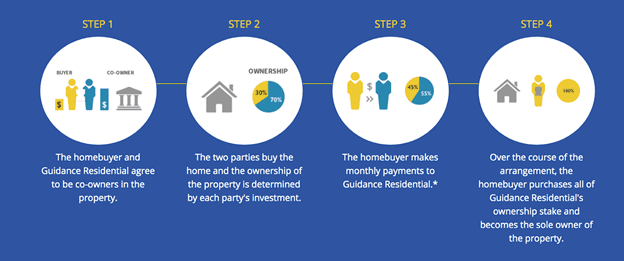
Guidance Residential’s proprietary model is a form of Diminishing Musharakah called the Declining Balance Co-ownership Program. Once the homebuyer and Guidance agree to co-own a property, the two parties buy the home together, and each side’s ownership share matches its investment. If you pay 20% of the purchase price, you own 20% of the home and Guidance owns 80%.
You then make monthly payments that do two things: purchase more of Guidance’s share, and compensate Guidance for the use of the share it still owns. Your stake grows with every payment until you own the home outright. You live in and benefit from the home the entire time, and the title carries your name from the start.
The model was developed with the help of six of the world’s leading Islamic finance scholars and is overseen by an independent Shariah Supervisory Board chaired by Justice (Ret.) Muhammad Taqi Usmani.
“Guidance Residential has established itself as the largest, the oldest, and the most successful of all Islamic home finance companies here in the United States. It has done so equitably, with great transparency.”
Shaykh Yusuf Talal DeLorenzo, Guidance Residential Shariah Supervisory Board member, in an April 2026 webinar
Guidance is also recognized by U.S. financial institutions and regulated like any other home financing in the United States.
Because Islamic finance requires partners to share risk, Guidance shares the risks of homeownership with you, and fees are capped, free of the hidden expenses of a conventional mortgage.
What Are the 4 Steps of the Islamic Home Buying Process?
Buying a home with halal financing involves the same four steps as any U.S. home purchase: application, processing, underwriting, and closing. The difference is that the contract itself is Shariah-compliant.
Step 1. Qualification or Application
Start by giving Guidance basic information about yourself and your finances to learn how much financing you may qualify for. A quick Pre-Qualification gives you a rough estimate of your price range, or you can move directly to your Pre-Approval application, where you submit documentation of income, employment, and savings.
Being Pre-Approved means you are ready to seriously shop. Realtors will expect it before showing homes, and it is also the first step if you want to refinance a home you already own. The entire application can be completed online, with documents uploaded from your phone, and a Guidance team member is always available to help.
What to do in this phase:
- Complete your Pre-Approval application
- Provide documentation
Step 2. Processing
Once you are under contract on a home, your Account Executive sends you a package with the contract amount, costs, fees, terms, and expected monthly payment. After you accept, you submit final documentation while Guidance gathers third-party items like the title work, flood report, and appraisal.
What to do in this phase:
- Provide additional financial documentation
- Work with your agent to arrange for your home inspection and appraisal
Step 3. Underwriting
A licensed underwriter at Guidance evaluates your financial information, confirms your eligibility, and ensures the application complies with federal regulations. They may request additional documents along the way, so respond promptly to keep your closing on schedule.
What to do in this phase:
- Be prepared to provide additional documentation
- Pay close attention to deadlines and details
Step 4. Closing
This is when your purchase is finalized and ownership transfers to you. You will meet with your Realtor, the seller’s Realtor, and typically a title company representative to sign the final paperwork and pay your closing costs. In the weeks before closing, keep your finances, job, and residence unchanged, and avoid large purchases that could affect your credit and delay your closing.
What to do in this phase:
- Keep everything the same with your job and finances
- Appear at closing and receive your keys
Frequently Asked Questions
Is an Islamic mortgage really halal?
Yes, when it is built on an authentic Islamic structure. Guidance Residential’s program is a true Musharakah (equity partnership) developed with six leading international scholars and continuously overseen and audited by an independent Shariah Supervisory Board. Read more about what makes it halal.
Do you have to be Muslim to get a halal mortgage?
No. Halal financing is open to people of all faiths, and many non-Muslim customers choose it for the equitable co-ownership structure and shared risk.
Is it harder to qualify for halal financing?
No. The process of qualifying for a halal mortgage is very similar to qualifying for a conventional mortgage. You provide documents like tax returns and pay stubs, and the financier reviews your credit. The requirements are comparable.
Is Islamic home financing recognized by U.S. financial institutions?
Yes. Guidance Residential’s Declining Balance Co-ownership Program is regulated the same way conventional home financing is. Guidance worked with 18 law firms to create a legal structure that is fully compliant with both Shariah and U.S. law.
Why does the profit rate look like an interest rate?
Guidance benchmarks its usage fee against conventional financing costs to create a sustainable business model and so customers can comparison shop with a competitive rate. A similar number does not make it the same contract: You are buying the home together as co-owners, not borrowing money.
What makes Islamic mortgage contracts hard to understand?
Three things feel unfamiliar at first: terms like Musharakah, Ijara, and Murabaha with no conventional equivalent, a co-ownership structure built through an LLC rather than a simple loan agreement, and a profit rate benchmarked to conventional rates, which some buyers mistake for interest. Once those three points click, the rest of the contract reads much like a standard home purchase agreement.
Ready to Learn More?
Guidance Residential has provided more than $12 billion in financing to nearly 45,000 families over 25 years. If you’re ready to explore halal financing for your home purchase, start with a quick pre-qualification. It’s free, fast, and there’s no obligation. You can also estimate your monthly payment with our finance calculators.
Learn more and get started on your home finance journey today.
Originally published October 2020, updated August 2026.